Introduction
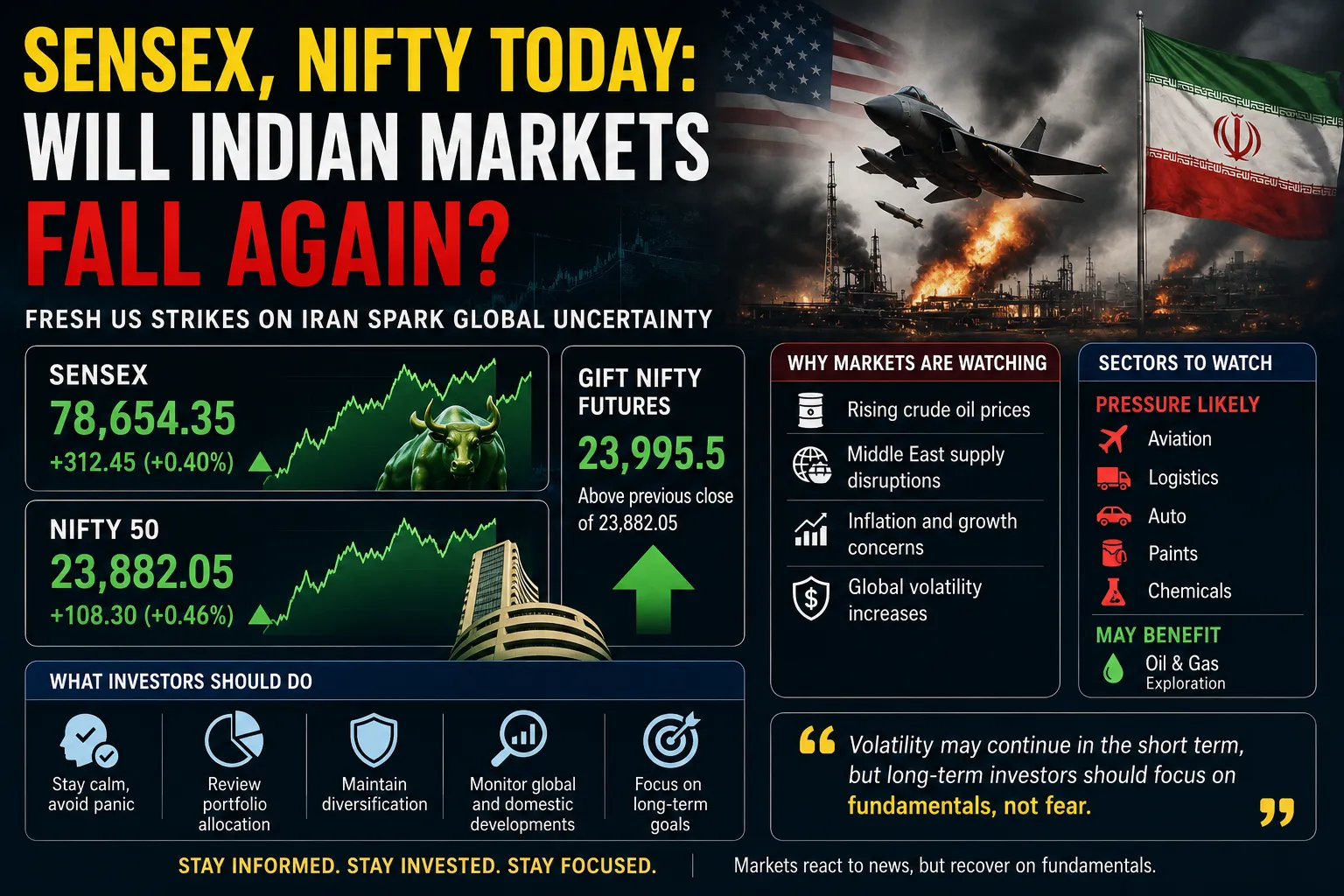
Indian stock market investors are closely watching global developments after the United States launched fresh military strikes on Iran, escalating geopolitical tensions in the Middle East. The renewed conflict has pushed crude oil prices higher, increased uncertainty in global financial markets, and raised concerns about how Indian benchmark indices—the Sensex and Nifty 50—will react. Despite these concerns, early market indicators suggested a positive opening for Indian equities, with GIFT Nifty futures trading around 23,995.5, above the previous Nifty 50 closing level of 23,882.05.
Geopolitical events often create short-term volatility, but their long-term impact depends on several factors, including the duration of the conflict, oil price movements, foreign investor sentiment, and domestic economic conditions. While investors are naturally worried about another sharp correction, market experts advise focusing on fundamentals rather than reacting emotionally to headlines. Understanding how global events influence Indian markets can help investors make more informed decisions during periods of uncertainty.
Why the US-Iran Conflict Matters for Financial Markets
The Middle East plays a crucial role in the global energy market. Any military escalation involving major oil-producing regions immediately affects investor confidence because of concerns about disruptions in crude oil supplies.
The latest US strikes on Iran have renewed fears over the security of shipping routes, particularly the Strait of Hormuz, one of the world’s busiest oil transportation corridors. Rising geopolitical risks generally encourage investors to shift money from equities into safer assets such as gold, government bonds, and the US dollar.
Major market concerns include:
- Rising crude oil prices.
- Supply chain disruptions.
- Higher inflation risks.
- Increased market volatility.
- Foreign investor caution.
GIFT Nifty Signals a Positive Opening
Despite global uncertainty, early trading in GIFT Nifty futures indicated that Indian markets could begin the day on a positive note. Futures were trading above the previous closing level of the Nifty 50, suggesting that investors were not expecting an immediate panic-driven sell-off at the opening bell.
However, futures only indicate the likely market direction before trading begins. Actual market performance depends on investor sentiment throughout the trading session, global market movements, institutional buying and selling, and fresh news developments.
Factors supporting the opening include:
- Positive GIFT Nifty trends.
- Stable domestic market sentiment.
- Selective buying by investors.
- Strong corporate fundamentals.
How Geopolitical Events Affect Indian Markets
Geopolitical conflicts often create uncertainty because investors struggle to estimate their economic impact. Markets generally dislike uncertainty more than bad news itself.
When conflicts escalate, investors become cautious, reducing exposure to riskier assets such as equities. Foreign Institutional Investors (FIIs) may temporarily reduce investments in emerging markets, including India, leading to increased volatility.
However, history shows that unless geopolitical tensions significantly affect global economic activity, markets often recover after the initial reaction.
Common market reactions include:
- Increased volatility.
- Temporary decline in equity prices.
- Rise in safe-haven investments.
- Higher demand for gold.
- Currency fluctuations.
Rising Oil Prices Could Influence Market Sentiment
One of the biggest concerns for India is the rise in crude oil prices. India imports a large portion of its crude oil requirements, making the economy sensitive to global energy price movements.
Following the renewed US-Iran conflict, international oil prices climbed as investors worried about possible disruptions to supplies through the Strait of Hormuz. Higher crude prices increase transportation and manufacturing costs, which can eventually contribute to inflation.
Higher oil prices can affect:
- Fuel costs.
- Transportation expenses.
- Manufacturing costs.
- Inflation.
- Corporate profitability.
Which Sectors Could Be Most Affected?
Not all sectors react the same way during geopolitical crises. Some industries face greater pressure because of higher input costs, while others may remain relatively resilient.
Sectors that consume large amounts of fuel or rely heavily on imported raw materials may experience margin pressure if crude oil prices remain elevated for an extended period.
Sectors that may face challenges include:
- Aviation.
- Paint manufacturers.
- Logistics companies.
- Automobile sector.
- Chemical manufacturers.
On the other hand, energy producers and companies involved in oil exploration may benefit from higher crude prices.
Will Foreign Investors Change Their Strategy?
Foreign Institutional Investors play a significant role in Indian equity markets. During periods of global uncertainty, FIIs often become cautious and may reduce exposure to emerging markets until geopolitical conditions stabilize.
However, investment decisions depend on multiple factors, including:
- Global interest rates.
- Economic growth.
- Currency stability.
- Corporate earnings.
- Market valuations.
India’s long-term economic outlook remains an important factor supporting foreign investment despite temporary global uncertainty.
Can the Indian Economy Handle External Shocks?
India has experienced multiple global crises over the past two decades, including financial crises, pandemics, geopolitical conflicts, and commodity price shocks.
Although external events create temporary volatility, India’s diversified economy, expanding domestic demand, infrastructure investments, and improving corporate earnings have often helped markets recover over time.
Investors continue monitoring:
- GDP growth.
- Inflation trends.
- Monetary policy.
- Corporate profitability.
- Government reforms.
Strong domestic fundamentals often provide support during periods of international uncertainty.
Historical Market Performance During Global Conflicts
Financial markets have historically reacted sharply to unexpected geopolitical events. Initial declines are often driven by uncertainty rather than long-term changes in economic fundamentals.
Once investors gain greater clarity regarding the duration and severity of the conflict, markets frequently stabilize. While every geopolitical event is different, history shows that long-term investors generally benefit from maintaining disciplined investment strategies instead of reacting emotionally to short-term volatility.
Past market behavior suggests:
- Initial volatility is common.
- Oil prices often react quickly.
- Equity markets usually stabilize.
- Fundamentals eventually regain importance.
What Should Retail Investors Do?
Periods of uncertainty often create anxiety among retail investors. However, financial experts generally recommend avoiding panic selling based solely on geopolitical headlines.
Instead, investors should focus on their financial goals, diversification, and long-term investment strategies.
Practical steps include:
- Avoid emotional decisions.
- Review portfolio allocation.
- Maintain diversification.
- Monitor market developments.
- Invest according to long-term goals.
- Keep emergency savings available.
Patience is often one of the most valuable qualities during volatile markets.
Key Factors Investors Should Watch
Market direction over the coming days will depend on several important developments beyond the initial news of military action.
Investors should monitor:
- Further developments in the US-Iran conflict.
- International crude oil prices.
- Foreign investment flows.
- Corporate earnings announcements.
- Inflation data.
- Central bank policy decisions.
These factors will likely have a greater influence on medium-term market trends than the initial geopolitical reaction.
Expert View: Volatility May Continue
Market analysts believe volatility could remain elevated if geopolitical tensions continue to increase. Rising energy prices, inflation concerns, and uncertainty surrounding global trade could influence investor sentiment in the short term.
However, many experts also emphasize that market corrections caused by geopolitical events have historically been temporary unless they significantly disrupt global economic growth or corporate earnings.
Long-term investors generally benefit more from disciplined investing than attempting to predict every short-term market movement.
Conclusion
The renewed US military strikes on Iran have once again brought geopolitical uncertainty into focus, creating fresh concerns for global financial markets. Rising crude oil prices, inflation fears, and cautious investor sentiment could contribute to increased volatility in the Sensex and Nifty 50 over the coming sessions. Nevertheless, early indications from GIFT Nifty futures suggested a relatively stable opening for Indian markets, highlighting that investors are balancing geopolitical risks with domestic economic strength.
While short-term market fluctuations are likely, long-term investment decisions should continue to be guided by economic fundamentals, corporate performance, and disciplined financial planning rather than temporary geopolitical events. Investors who remain patient, diversified, and focused on their long-term objectives are generally better positioned to navigate periods of market uncertainty successfully.