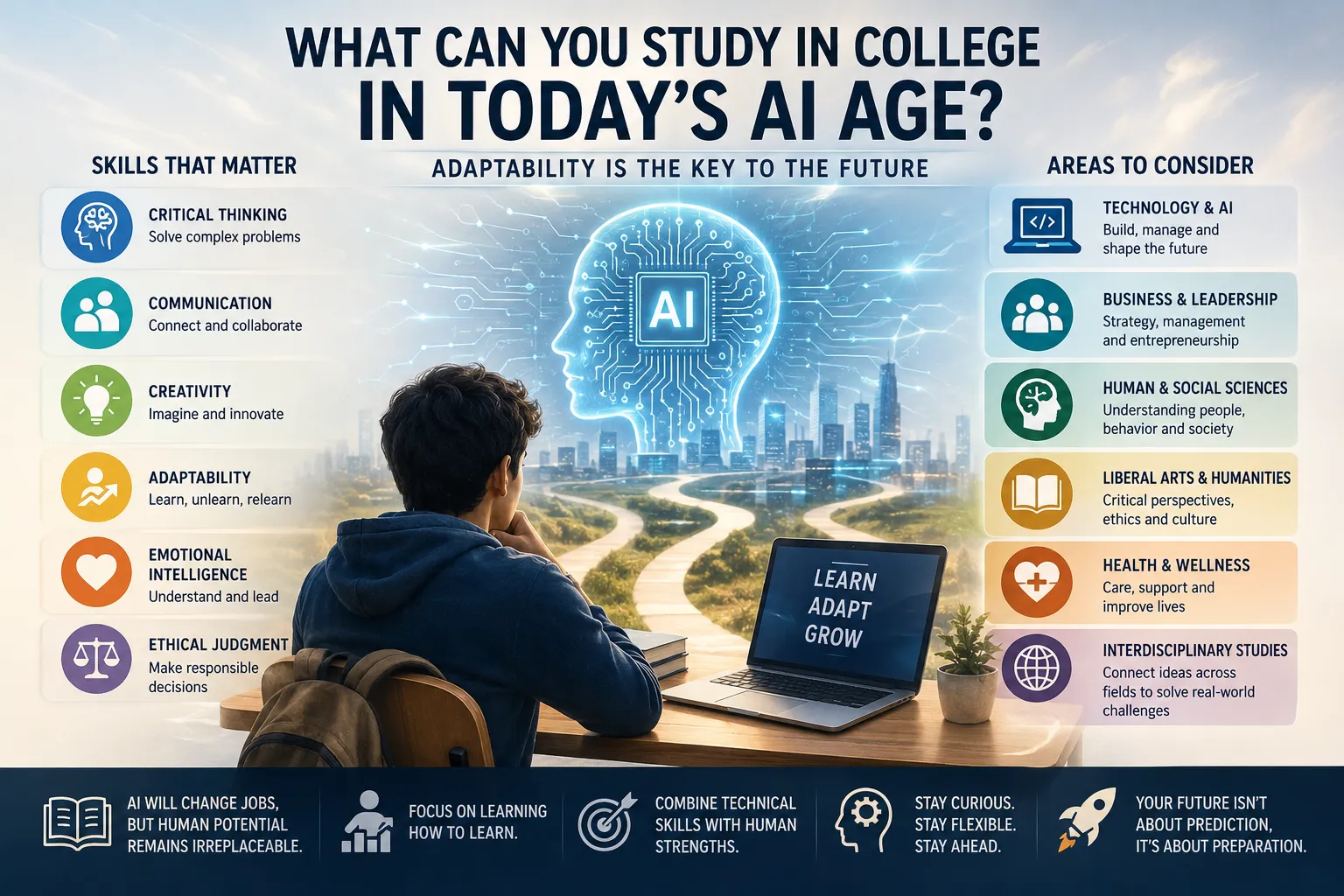
Artificial intelligence is transforming the way people work, learn, and build careers. As AI systems become increasingly capable of performing tasks that once required years of human training, students and parents around the world are asking a critical question: What should an 18-year-old study in college today?
This question recently gained widespread attention after a discussion involving Anthropic’s AI assistant, Claude, circulated on social media platform X. The exchange focused on how young people should prepare for a future shaped by rapidly advancing AI technologies. Rather than recommending a specific degree or predicting which profession would dominate the next few decades, Claude emphasized a different idea: adaptability.
The conversation quickly sparked debate among educators, technology experts, students, and industry leaders. Some agreed that flexibility and lifelong learning are becoming more valuable than any single technical skill. Others argued that traditional academic disciplines still provide a strong foundation for long-term success. The discussion highlights a broader challenge facing today’s generation as they prepare for careers in an AI-driven world.
The End of Predictable Career Paths
For decades, career planning followed a relatively straightforward formula. Students selected a field of study, acquired specialized knowledge, and pursued a profession related to their degree. While technological change always existed, most industries evolved gradually enough for workers to build careers spanning several decades.
Today, the pace of innovation is dramatically different. AI systems can already generate content, analyze data, write software code, assist with research, and automate numerous workplace tasks. Experts increasingly believe that many jobs will change significantly over the next ten years, while entirely new professions may emerge.
This uncertainty makes long-term predictions difficult. A profession that appears secure today could look very different by the time current college freshmen graduate. As a result, many experts argue that students should focus less on forecasting specific job titles and more on developing skills that remain valuable regardless of technological changes.
Why Adaptability Matters More Than Ever
Claude’s response centered on the idea that the future belongs to people who can learn, adapt, and evolve alongside technology. This perspective reflects a growing consensus among economists, business leaders, and educators.
In the AI era, knowledge itself is becoming increasingly accessible. Information that once required extensive training can often be retrieved instantly through digital tools. Consequently, employers are placing greater value on abilities that machines struggle to replicate fully.
Adaptability includes several important qualities:
- Continuous learning
- Critical thinking
- Problem-solving
- Communication
- Creativity
- Emotional intelligence
- Collaboration
- Ethical decision-making
These capabilities allow individuals to navigate changing environments and acquire new expertise when industries evolve. Rather than mastering a fixed set of skills, successful professionals may need to reinvent themselves multiple times throughout their careers.
The Rise of Human-Centered Skills
The debate surrounding AI has also renewed interest in human-centered disciplines. While technical expertise remains important, many industry leaders emphasize the value of skills rooted in human interaction and judgment.
Recent discussions among AI executives have highlighted the importance of tasks involving communication, leadership, relationship-building, and understanding human behavior. These areas remain difficult for AI systems to replicate effectively because they require empathy, context, trust, and nuanced decision-making.
Fields such as psychology, education, healthcare, business leadership, public policy, and communication may continue to offer significant opportunities because they rely heavily on human relationships. Even within highly technical industries, professionals who can bridge the gap between technology and people are becoming increasingly valuable.
This does not mean students should avoid technical subjects. Instead, many experts recommend combining technical literacy with strong interpersonal and analytical skills.
Should Students Still Study STEM?
One of the most controversial aspects of the debate concerns STEM education—science, technology, engineering, and mathematics.
Some observers worry that AI could automate portions of software development, data analysis, and other technical work. However, most experts do not believe technical education is becoming irrelevant. Instead, the nature of technical work is changing.
Students studying computer science, engineering, mathematics, or related disciplines may increasingly focus on:
- Designing AI systems
- Managing automated workflows
- Evaluating AI-generated outputs
- Solving complex interdisciplinary problems
- Developing ethical AI frameworks
The demand for technical knowledge is unlikely to disappear. However, professionals who combine technical expertise with creativity, strategic thinking, and communication skills may enjoy the greatest advantages.
The Surprising Return of the Liberal Arts
Interestingly, the AI era has also renewed appreciation for liberal arts education. Subjects such as history, philosophy, literature, sociology, and political science are receiving fresh attention because they cultivate analytical thinking and the ability to interpret complex human experiences.
Many technology leaders now argue that understanding people, culture, ethics, and society is becoming more important as AI becomes integrated into daily life. Questions surrounding privacy, fairness, misinformation, regulation, and human values require perspectives that extend beyond coding and engineering.
Philosophers, historians, and social scientists are increasingly contributing to discussions about responsible AI development. As a result, interdisciplinary education is gaining popularity.
Students who can connect insights from multiple fields may be particularly well-positioned for future opportunities.
The Importance of AI Literacy
Regardless of a student’s major, AI literacy is rapidly becoming essential.
Just as digital literacy became necessary in the internet age, understanding AI tools is becoming a fundamental workplace skill. Students do not necessarily need to become AI engineers, but they should understand how AI systems work, their limitations, and how to use them effectively.
AI literacy includes:
- Understanding AI capabilities
- Evaluating AI-generated information
- Recognizing bias and inaccuracies
- Using AI for productivity and research
- Applying ethical principles to AI use
Workers who know how to collaborate with AI systems are likely to gain significant productivity advantages compared with those who ignore the technology.
Building a Future-Proof Education
The debate sparked by Claude ultimately reveals that there may not be a single “safe” degree in the AI age. The future is too dynamic for simple predictions.
Instead of searching for a perfect major, students may benefit more from asking broader questions:
- Does this field teach me how to learn?
- Does it strengthen my critical thinking?
- Does it help me solve real-world problems?
- Does it improve my ability to work with people?
- Does it prepare me to use emerging technologies effectively?
The most resilient educational paths are likely to combine deep knowledge in one area with broad exposure to multiple disciplines.
Conclusion
Claude’s answer resonated with many people because it challenged the traditional idea that career success depends on choosing the “right” major. In a world where AI is reshaping industries at unprecedented speed, adaptability may become the most valuable skill of all.
Rather than focusing solely on predicting which jobs will survive automation, students should prioritize learning how to think, communicate, innovate, and continuously acquire new knowledge. Technical expertise remains important, but it is increasingly complemented by creativity, emotional intelligence, ethical reasoning, and interdisciplinary thinking.
The AI age is not eliminating the need for education—it is redefining what a valuable education looks like. Students who embrace lifelong learning and develop both technical and human-centered skills will likely be best equipped to thrive in whatever future emerges.