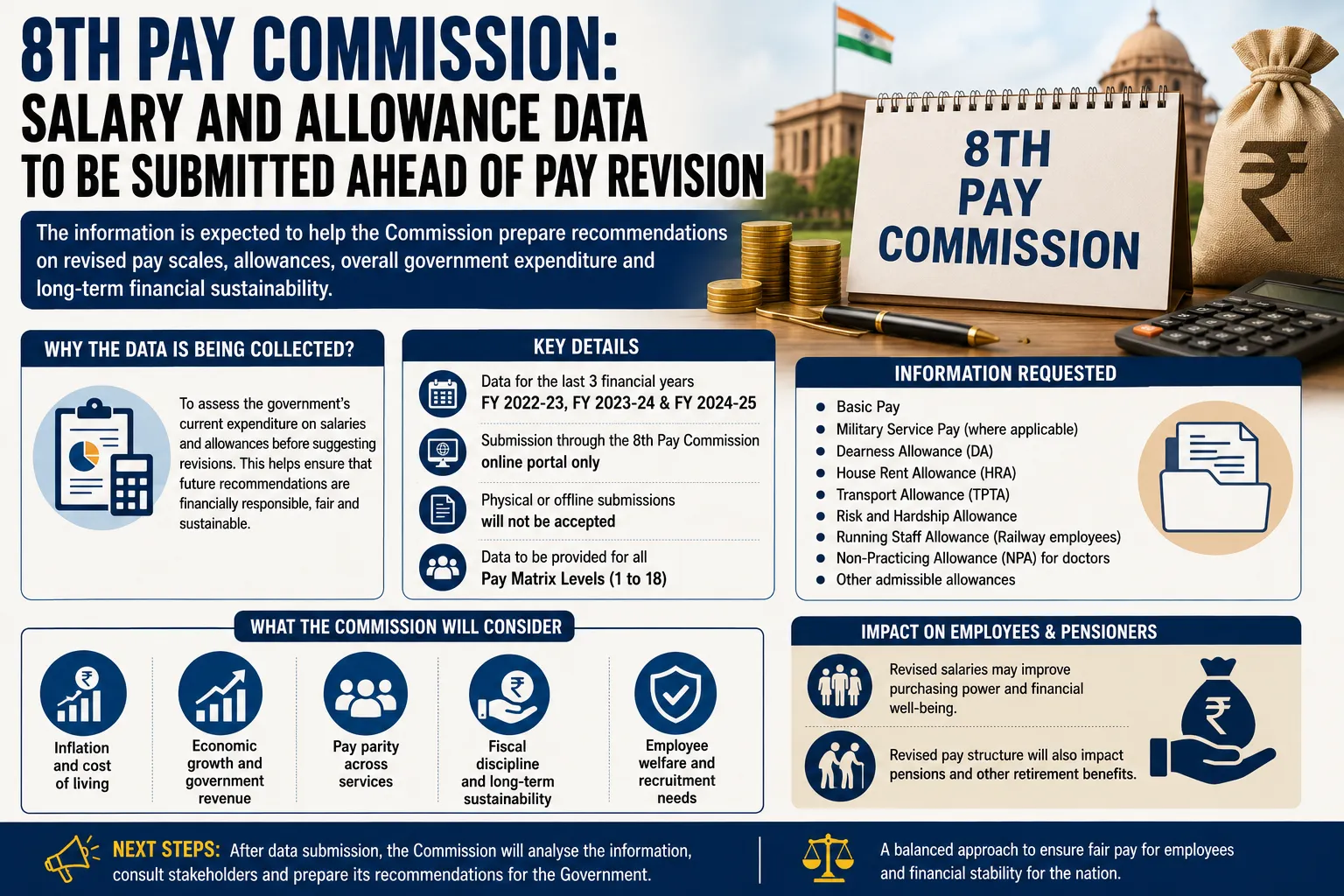
The 8th Pay Commission has entered a crucial stage in its work as Central government ministries, departments, and organizations have been directed to submit detailed salary and allowance data through the Commission’s online portal. This exercise is expected to provide the Commission with a comprehensive understanding of the government’s current expenditure on employee compensation before it prepares recommendations for revised pay scales and allowances.
The data collection process is one of the first major steps in determining how salaries, pensions, and allowances for millions of Central government employees and pensioners may be revised in the coming years. Rather than focusing solely on salary increases, the Commission aims to evaluate the broader financial implications of any proposed changes, ensuring that future recommendations remain financially sustainable while addressing the needs of government employees.
What Is the 8th Pay Commission?
The Central Pay Commission is a government-appointed body responsible for reviewing and recommending revisions to the salaries, pensions, and allowances of Central government employees and pensioners. Traditionally constituted every ten years, each Pay Commission evaluates changes in the economy, inflation, living costs, and public finances before suggesting a revised compensation structure.
The Union Government approved the formation of the 8th Pay Commission to continue this periodic review process. Its recommendations are expected to affect millions of serving employees as well as pensioners across various ministries, departments, and government organizations.
Why Salary and Allowance Data Is Being Collected
Before proposing any revision in salaries, the Commission must first understand the government’s existing expenditure.
To achieve this, ministries and departments have been instructed to upload detailed financial information relating to employee compensation. The Commission has requested expenditure data covering the last three completed financial years—FY 2022-23, FY 2023-24, and FY 2024-25.
This information will help assess current spending patterns across different Pay Matrix Levels and determine the financial impact of any future revisions. The exercise is intended to create a reliable database that will support evidence-based recommendations rather than estimates or assumptions.
Online Submission Only
The Commission has specified that all information must be submitted exclusively through its online data portal.
Physical documents, printed reports, spreadsheets sent by email, or offline submissions will not be accepted. The digital-only approach aims to standardize data collection, improve accuracy, and simplify analysis.
Creating a centralized digital database will also enable the Commission to compare expenditure across ministries more efficiently while reducing administrative delays.
What Information Has Been Requested?
The Commission has asked departments to provide a detailed breakdown of salary-related expenditure across every Pay Matrix Level, from Level 1 to Level 18.
The requested information includes Basic Pay, Military Service Pay where applicable, Dearness Allowance (DA), House Rent Allowance (HRA), Transport Allowance (TPTA), Risk and Hardship Allowance, Running Staff Allowances for railway employees, Non-Practicing Allowance (NPA) for eligible medical professionals, and other admissible allowances.
Rather than examining only total salary payments, the Commission wants a complete picture of how government compensation is distributed across different categories.
Why This Exercise Is Important
Salary revision is a complex financial exercise that affects not only government employees but also the Union Budget and long-term public expenditure.
Before recommending changes, the Commission must estimate how revised pay scales and allowances would influence annual government spending. The collected data will help determine whether proposed revisions remain fiscally sustainable while addressing employees’ expectations amid rising living costs.
Accurate financial information is therefore essential to balancing employee welfare with responsible public finance management.
Factors the Commission Is Likely to Consider
Although the Commission has not announced its final recommendations, Pay Commissions traditionally evaluate several economic and administrative factors before suggesting revisions.
Inflation, reflected through changes in the cost of living, remains one of the most significant considerations. Economic growth, government revenue, fiscal discipline, salary comparisons across public services, recruitment trends, and employee welfare are also important elements.
The Commission is expected to examine whether the existing pay structure adequately reflects current economic conditions while ensuring that revised compensation remains affordable for the government over the long term.
Understanding the Fitment Factor
One of the most discussed aspects of every Pay Commission is the fitment factor.
The fitment factor is a multiplier used to convert existing basic pay into revised basic pay under the new pay structure. It directly influences the increase in an employee’s basic salary, which subsequently affects several allowances linked to basic pay.
Although various estimates regarding possible fitment factors have appeared in public discussions, no official figure has been finalized. The actual multiplier will only become clear after the Commission completes its analysis and submits its recommendations.
Impact on Government Employees
The recommendations of the 8th Pay Commission are expected to influence the financial well-being of millions of Central government employees.
Revised salaries could improve purchasing power, help employees manage rising living costs, and enhance overall financial security.
Higher basic pay may also affect retirement benefits because pensions and several post-retirement calculations are linked to salary structures.
For many employees, the Pay Commission represents an important milestone in long-term financial planning.
What It Means for Pensioners
The Commission’s work extends beyond serving employees.
Central government pensioners are also expected to benefit from revised pension calculations once new recommendations are implemented.
Since pension structures are generally linked to revised pay scales, changes in salary frameworks may influence retirement benefits, family pensions, and other retirement-related entitlements.
This makes the Commission’s recommendations significant for both current employees and retired personnel.
Fiscal Responsibility Remains a Priority
While employees naturally anticipate improved compensation, the government must also consider fiscal sustainability.
Salary revisions affect not only annual expenditure but also future pension liabilities, administrative costs, and long-term budget planning.
The Commission’s recommendations are therefore expected to balance employee welfare with responsible financial management.
A sustainable pay structure ensures that future governments can continue supporting employee compensation without creating excessive fiscal pressure.
What Happens Next?
Once ministries and departments complete data submission, the Commission will begin analysing the information.
The collected financial data will form the foundation for detailed discussions on salary structures, allowances, expenditure patterns, and possible revisions.
Following this analytical phase, consultations with stakeholders and further evaluation are expected before the Commission prepares its final recommendations for submission to the government.
Only after the government reviews and accepts those recommendations will revised pay structures be implemented.
Conclusion
The submission of salary and allowance data marks a critical milestone in the work of the 8th Pay Commission. By collecting detailed expenditure information from ministries and government departments, the Commission is laying the groundwork for evidence-based recommendations on future pay scales, allowances, and pension structures. This process is not merely an administrative exercise but a comprehensive assessment of how government compensation can evolve while remaining financially sustainable.
For millions of Central government employees and pensioners, the Commission’s work represents the possibility of updated salaries that better reflect present-day economic realities. At the same time, the government’s emphasis on accurate data collection demonstrates its intention to ensure that any future revisions are based on careful financial analysis rather than assumptions. As the Commission progresses through its evaluation, employees across the country will be closely watching the next stages of one of the most significant public sector pay revision exercises.