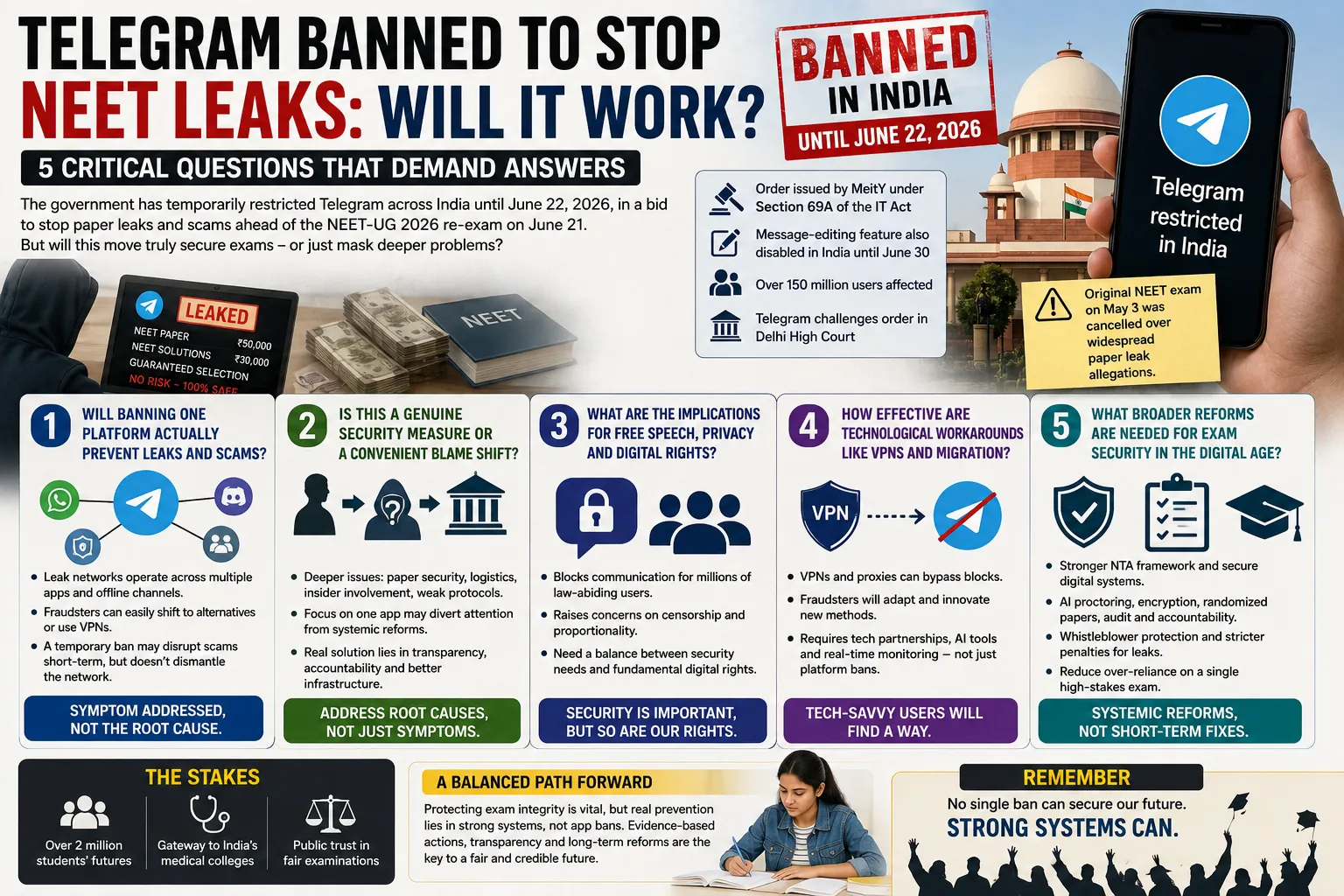
In a dramatic move amid ongoing concerns over examination integrity, the Indian government has temporarily restricted access to Telegram across the country until June 22, 2026. The decision, issued by the Ministry of Electronics and Information Technology (MeitY) under Section 69A of the IT Act, aims to prevent the spread of leaked papers and fraudulent claims ahead of the NEET-UG 2026 re-examination scheduled for June 21. This follows the cancellation of the original May 3 exam due to widespread allegations of paper leaks, which triggered a CBI investigation and public outrage. While the step reflects urgent efforts to safeguard one of India’s most critical entrance tests for over two million medical aspirants, it has ignited intense debates on censorship, technological efficacy, and systemic reforms.
The ban also includes directives to disable Telegram’s message-editing feature in India until June 30, addressing allegations that scammers used it to fabricate post-exam “proof” of leaks by editing older messages while retaining timestamps. With over 150 million users in India, the restriction has disrupted communication for many, prompting Telegram to challenge the order in the Delhi High Court as “grossly disproportionate.” As discussions swirl online and offline, here are five essential questions that must be addressed to evaluate whether this measure will truly curb paper leaks or merely offer a temporary illusion of control.
1. Will Banning One Platform Actually Prevent Leaks and Scams?
The core rationale behind the ban is Telegram’s alleged role as a hub for cheating networks. Authorities point to channels and groups selling purported NEET papers for hefty sums (reports mention ₹14,000 to ₹1 lakh or more) and circulating fake videos and PDFs. The National Testing Agency (NTA) has repeatedly warned students against such scams, emphasizing that no authentic papers have leaked outside secure chains for the re-exam.
However, experts and critics question the platform-specific approach. Sophisticated leak networks operate through multiple channels—WhatsApp groups, encrypted apps, Discord, or even offline methods. Fraudsters can easily migrate to alternatives or use VPNs to bypass restrictions, as seen in past digital crackdowns. The temporary nature of the ban (until just after the re-exam) may disrupt immediate scams but does little to dismantle organized rackets involving insiders, such as those probed in the original leak case. Without robust, ongoing monitoring and international cooperation with platforms, the underlying distribution networks remain intact.
2. Is This a Genuine Security Measure or a Convenient Blame Shift?
The NEET controversy exposed deeper vulnerabilities in the examination ecosystem, from question paper security and logistics to coordination among multiple agencies. The original exam’s cancellation led to significant distress for aspirants, with demands for accountability from the NTA and Ministry of Education. Deploying the Indian Air Force for secure transport of papers in the re-exam shows heightened physical measures, yet the spotlight on Telegram raises suspicions of deflection.
Many view the ban as addressing symptoms rather than root causes like inadequate vetting of printing presses, weak chain-of-custody protocols, or delays in investigations. While Telegram’s non-responsiveness in aiding probes is cited, the platform claims it has proactively removed hundreds of unlawful NEET-related links and groups. Critics argue that systemic reforms—such as digital watermarking, AI-based proctoring, randomized question sets, and faster CBI processes—would yield more sustainable results than targeting a single messaging app.
3. What Are the Implications for Free Speech, Privacy, and Digital Rights?
Blocking access to a widely used platform for millions of legitimate users—students, professionals, businesses, and communities—has sparked concerns over proportionality. Telegram serves as a vital tool for education, news dissemination, and private communication in a country with diverse linguistic and regional needs. The Delhi High Court petition by Telegram highlights the broad impact, with CEO Pavel Durov publicly criticizing the move as punishing ordinary citizens while failing to target perpetrators.
This incident revives broader debates on internet shutdowns and content blocking in India. Under Section 69A, such orders require justification for sovereignty, security, or public order, but judicial precedents stress necessity and minimal restraint. Opponents, including some political voices, decry it as knee-jerk censorship that erodes trust in digital governance. Supporters counter that exam integrity for a high-stakes test affecting millions justifies short-term inconvenience. Balancing these requires transparent guidelines and post-facto reviews to prevent misuse.
4. How Effective Are Technological Workarounds Like VPNs and Platform Migration?
Tech-savvy users and determined fraudsters can circumvent app blocks relatively easily. VPN services, proxy servers, and mirrored websites allow continued access, potentially driving underground activity rather than eliminating it. Past experiences with similar restrictions on other platforms demonstrate that motivated actors adapt quickly, often leading to more fragmented and harder-to-track ecosystems.
Moreover, the ban’s focus on message editing addresses a specific exploit but may encourage scammers to innovate new tactics. Long-term efficacy depends on collaboration between the government, platforms, and cybersecurity experts to implement features like enhanced verification, rapid takedown protocols, and AI detection of exam-related misinformation. Without such partnerships, isolated bans risk becoming symbolic gestures with limited deterrence.
5. What Broader Reforms Are Needed for Exam Security in the Digital Age?
The NEET saga underscores the challenges of conducting large-scale examinations in an era of instant connectivity. With millions of aspirants, the stakes are extraordinarily high, influencing careers, social mobility, and the nation’s healthcare workforce. Sustainable solutions must go beyond reactive bans to holistic overhauls: strengthening the NTA’s institutional framework, investing in secure digital infrastructure, enhancing whistleblower protections, and imposing stricter penalties on leaks.
Public trust hinges on transparency—timely communication about security protocols, swift resolution of grievances, and independent audits. Encouraging ethical hacking and cybersecurity integration in exam processes could proactively identify vulnerabilities. Additionally, reducing over-reliance on a single high-stakes test through alternative admission pathways might alleviate some pressure that fuels malpractices.
Charting a Balanced Path Forward
The Telegram restriction is a short-term tactical response in a high-pressure situation, but its success will ultimately be measured by the smoothness of the June 21 re-exam and long-term decline in leaks. It highlights the tension between rapid action and thoughtful policy in India’s evolving digital landscape. While protecting examination sanctity is non-negotiable, measures must be evidence-based, proportionate, and accompanied by systemic fixes.
As the Delhi High Court hears the challenge and the re-exam approaches, stakeholders—including students, parents, educators, and policymakers—must engage in constructive dialogue. True prevention of paper leaks lies not in banning apps but in building resilient systems that withstand digital disruptions. Only then can India’s competitive examinations regain the credibility essential for nurturing the next generation of professionals. The current episode serves as a critical reminder: technology amplifies both opportunities and risks, demanding adaptive, multifaceted governance rather than singular fixes.