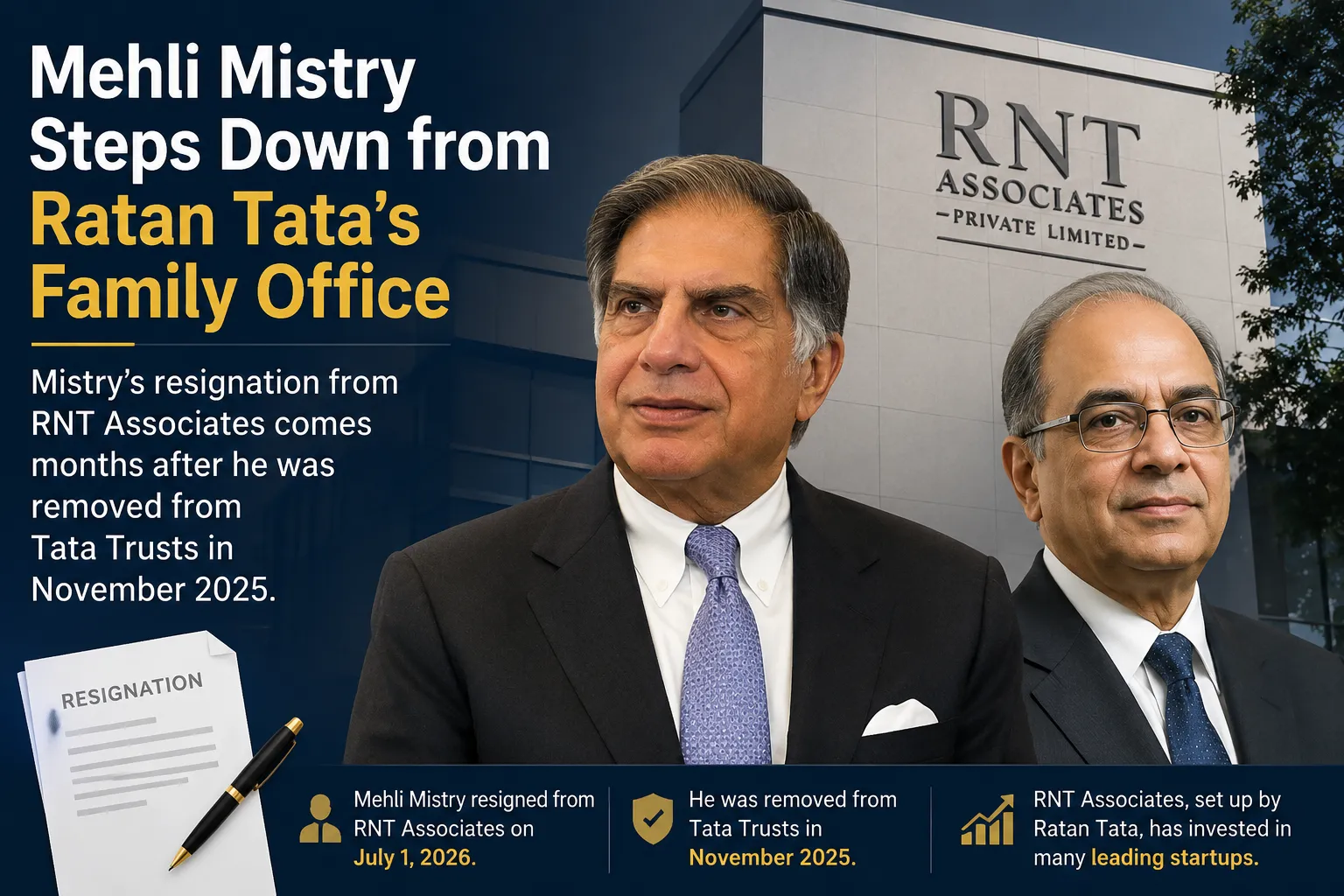
The resignation of Mehli K. Mistry from RNT Associates Pvt. Ltd., the family office established by the late industrialist Ratan Tata, marks another significant development in the ongoing changes within the Tata ecosystem. Mistry, who spent decades as one of Ratan Tata’s closest advisers and trusted associates, officially stepped down from the board of RNT Associates effective July 1, 2026, citing his “preoccupation with other commitments.” His resignation follows his exit from Tata Trusts in late 2025 and further signals the conclusion of one of the longest-standing professional relationships within the Tata Group’s leadership circle.
Although the resignation itself was presented as a routine board-level change, it carries wider significance because of Mistry’s long association with Ratan Tata, his involvement in managing personal investments, and his influential role across several Tata-linked institutions.
Who Is Mehli Mistry?
Mehli K. Mistry has long been regarded as one of the most respected corporate professionals associated with the Tata Group. Over several decades, he built a reputation for his financial expertise, governance experience, and close working relationship with Ratan Tata.
Apart from serving on various boards, Mistry became one of the executors of Ratan Tata’s will, highlighting the enormous trust placed in him by the veteran industrialist. Throughout his career, he remained largely away from the public spotlight despite playing an important role behind the scenes in several strategic matters.
His understanding of corporate governance, investments, philanthropy, and business management made him one of the most influential advisers within Tata’s extended leadership network.
What Is RNT Associates?
RNT Associates Pvt. Ltd. was established in 2009 as Ratan Tata’s personal investment office. Unlike Tata Sons or Tata Trusts, RNT Associates managed the late chairman’s private investment portfolio rather than the group’s corporate businesses.
The company became well known for backing India’s startup ecosystem at an early stage. Through RNT Associates, Ratan Tata invested in numerous emerging businesses across sectors including technology, mobility, financial services, healthcare, consumer products, and e-commerce.
Over the years, RNT Associates invested in several prominent startups including Paytm, Ola, BlueStone, and multiple other innovative companies that later became major players in India’s startup landscape.
Besides startup investments, the company also generated income through consultancy services and dividend earnings from its investment portfolio.
Details of Mehli Mistry’s Resignation
According to reports, Mehli Mistry submitted his resignation letter on June 30, 2026, informing the board that he wished to step down due to his other professional commitments. His resignation became effective from July 1.
The move came slightly more than three years after he joined the board of RNT Associates.
Neither the company nor Mistry has publicly indicated any additional reasons behind the decision beyond the statement contained in his resignation letter.
While board resignations are common in corporate governance, Mistry’s departure has attracted considerable attention because of his historical relationship with Ratan Tata and the important role he played within Tata’s personal investment ecosystem.
The Connection with Tata Trusts
The resignation from RNT Associates comes months after Mistry’s departure from Tata Trusts during a period of governance changes following Ratan Tata’s passing.
In November 2025, Mistry ceased to be associated with key Tata Trusts after disagreements surrounding governance and trustee appointments. Following those developments, he also initiated legal proceedings challenging aspects of his removal before the Maharashtra Charity Commissioner.
His exit from RNT Associates therefore represents another important step in his gradual disengagement from institutions closely associated with the Tata legacy.
Why This Exit Matters
While RNT Associates operates separately from Tata Sons and Tata Trusts, the organization occupies a unique position within the broader Tata ecosystem because it represents Ratan Tata’s personal investment vision.
Mistry was not merely a director but someone who had worked closely alongside Ratan Tata for decades. His understanding of the investment philosophy, entrepreneurial ecosystem, and governance principles made him an important figure within the organization.
His departure symbolizes the gradual transition from leadership closely connected with Ratan Tata’s personal network toward a newer administrative structure.
For observers of corporate governance, this transition reflects how institutions evolve following the passing of influential founders and leaders.
Current Leadership at RNT Associates
Following Mistry’s resignation, the board of RNT Associates continues to include several individuals closely connected to the Tata family and Tata Sons.
Among its directors are Ratan Tata’s half-sisters, Shireen Jejeebhoy and Deanna Jejeebhoy. The board also includes senior Tata Sons executive Jamsheed Poncha and Tata Sons General Counsel Sidharth Sharma.
Their presence provides continuity in managing Ratan Tata’s personal investment portfolio while maintaining governance oversight over the company’s future activities.
Ratan Tata’s Investment Legacy
Perhaps the greatest contribution of RNT Associates lies in its role in encouraging entrepreneurship across India.
Long before startup investing became mainstream among established industrialists, Ratan Tata personally supported numerous founders working on innovative business ideas.
His investments were often viewed as endorsements of entrepreneurial potential rather than purely financial decisions.
Many startup founders have publicly acknowledged that receiving investment from Ratan Tata provided credibility, industry recognition, and confidence that extended beyond financial capital.
Through RNT Associates, this philosophy helped shape India’s startup ecosystem during a period of rapid technological transformation.
Corporate Governance and Succession
Large business groups often undergo significant governance changes following leadership transitions.
As institutions mature, board compositions naturally evolve to reflect changing strategic priorities, succession planning, regulatory expectations, and governance frameworks.
The changes witnessed across Tata-linked entities over the past year illustrate how even highly respected corporate institutions periodically reorganize their leadership structures while maintaining continuity in operations.
Such transitions are an important part of institutional resilience and long-term governance.
What Happens Next?
RNT Associates is expected to continue managing Ratan Tata’s personal investment portfolio under its existing board structure.
The company remains an important investment vehicle with stakes in several startups and other private investments built over many years.
Meanwhile, Mehli Mistry continues to remain active in other professional responsibilities outside RNT Associates. His experience in finance, governance, and corporate leadership ensures that he will continue to be an influential figure in India’s business community despite stepping away from Tata’s family office.
Conclusion
Mehli Mistry’s resignation from RNT Associates marks the end of another chapter in the post-Ratan Tata transition within the Tata ecosystem. Having served as one of Ratan Tata’s closest confidants, trusted adviser, and executor of his will, Mistry played a vital role in shaping the governance and investment philosophy of the late industrialist’s personal office.
Although his resignation was officially attributed to other professional commitments, its timing—following his earlier exit from Tata Trusts—highlights the broader leadership changes taking place across Tata-linked institutions. As RNT Associates moves forward under its current board, the focus will remain on preserving Ratan Tata’s investment legacy while adapting to a new era of governance and leadership.