Embarking on a journey toward financial stability can feel overwhelming for beginners, but setting clear, actionable goals is the foundation of smart money planning. Financial goals provide direction, motivation, and a measurable path to achieving short-term security and long-term prosperity. Whether you are just starting your career, managing student debt, or planning for major life events, understanding how to define and pursue realistic objectives can transform your relationship with money.
This guide outlines practical financial goals examples tailored for beginners, emphasizing the SMART framework—Specific, Measurable, Achievable, Relevant, and Time-bound—to ensure success. By focusing on foundational habits like budgeting, saving, and debt management, newcomers can build confidence and resilience against unexpected challenges.
Understanding the SMART Framework for Financial Goals
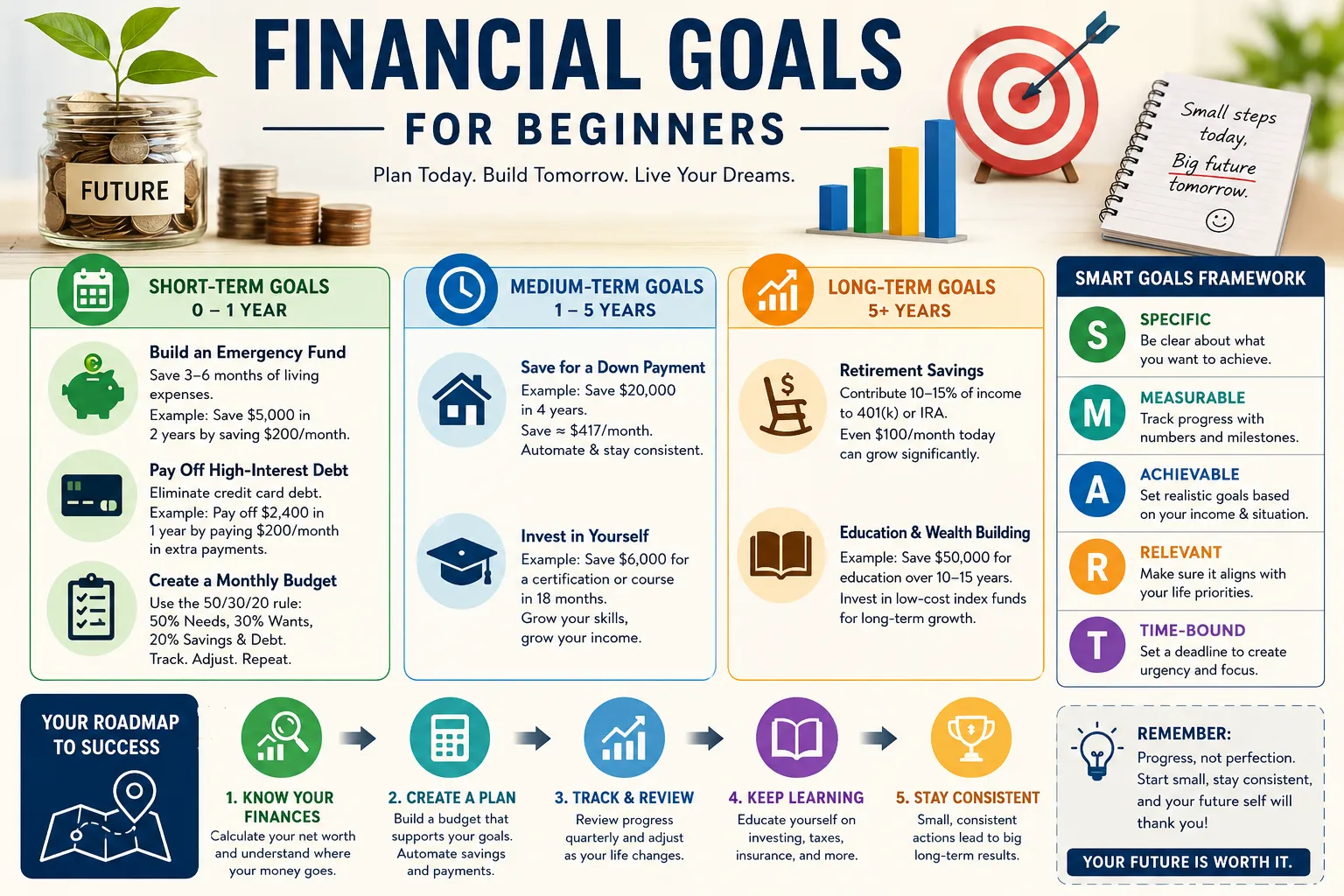
Effective goals avoid vagueness such as “save more money.” Instead, they follow the SMART criteria to create clarity and accountability. A specific goal details exactly what you want to accomplish. It must be measurable with clear milestones, achievable based on your income and circumstances, relevant to your broader life priorities, and time-bound with a realistic deadline.
For beginners, start small to build momentum. Track progress monthly using simple spreadsheets or budgeting apps, and adjust as needed. This structured approach turns abstract aspirations into concrete plans, fostering discipline and reducing financial stress over time.
Short-Term Goals: Building Immediate Financial Security
Short-term goals typically span less than one year and focus on creating stability. A foundational example is building an emergency fund. Aim to save three to six months of essential living expenses in a liquid, accessible account. For instance, target $5,000 within two years by setting aside a fixed monthly amount, such as $200, automatically transferred to a high-yield savings account. This buffer covers unexpected events like medical bills or car repairs without derailing your progress.
Another key short-term goal is paying off high-interest credit card debt. Suppose you carry $2,400 in balances at 20% interest. A SMART goal could be to eliminate it within one year by making consistent extra payments of $200 monthly while cutting non-essential spending. Prioritizing high-interest debt first (the debt avalanche method) minimizes total interest paid and frees up future cash flow.
Creating and sticking to a monthly budget is equally vital. Using the 50/30/20 rule—allocating 50% of income to needs, 30% to wants, and 20% to savings and debt—provides a simple starting framework. Track expenses for one month to identify leaks, then refine categories for better alignment with your goals.
Medium-Term Goals: Planning for Major Milestones
Medium-term goals, spanning one to five years, bridge immediate stability and long-term dreams. Saving for a down payment on a home or vehicle is a common example. Set a target of $20,000 for a house down payment over four years, requiring roughly $417 monthly contributions. Automate transfers and explore low-risk investment options like certificates of deposit to grow savings modestly while preserving capital.
Funding education or skill development also fits here. Beginners might aim to save $6,000 for a certification course or professional development over 18 months. This investment in human capital often yields higher future earnings, making it a relevant and achievable step toward career growth.
Long-Term Goals: Securing Your Future
Long-term goals focus on retirement, wealth building, and legacy planning, often extending beyond five years. Starting retirement savings early leverages compound interest powerfully. A beginner goal could be contributing consistently to a retirement account, such as increasing 401(k) or IRA contributions to 10-15% of income annually. Even modest starts, like $100 monthly, accumulate significantly over decades.
Another example is saving for a child’s education or your own advanced degree. Targeting $50,000 in a dedicated account over 10-15 years through regular investments and tax-advantaged plans provides a structured path. Diversifying into low-cost index funds helps balance growth and risk appropriate for beginners.
Integrating Goals into a Comprehensive Money Plan
Successful money planning connects goals across timelines. Begin by assessing your current net worth—assets minus liabilities—to establish a baseline. Create a budget that supports multiple objectives simultaneously, such as allocating portions to emergency savings, debt repayment, and retirement. Automate as much as possible to reduce reliance on willpower.
Review progress quarterly. Life changes like income increases or unexpected expenses may require adjustments. Educate yourself continuously on topics like investing basics, tax optimization, and insurance needs to support your goals. For beginners, focusing on one or two priorities initially prevents overwhelm.
Overcoming Common Challenges for Beginners
Many newcomers struggle with inconsistent income, lifestyle inflation, or lack of knowledge. Combat these by starting with micro-habits, such as the 48-hour rule for impulse purchases or tracking every expense for 30 days. Seek free resources or community support to build literacy without high costs. Remember that progress, not perfection, matters—small, consistent actions compound into significant results.
Inflation, market volatility, and personal circumstances add complexity, so maintain flexibility. An emergency fund acts as a safety net, while diversification in investments mitigates risks for longer-term objectives.
Conclusion
Setting financial goals is not about restriction but empowerment. For beginners, examples like building an emergency fund, eliminating high-interest debt, following a structured budget, saving for major purchases, and investing in retirement provide a clear roadmap to financial well-being. By applying the SMART framework and integrating short-, medium-, and long-term objectives, you create sustainable habits that withstand life’s uncertainties.
Smart money planning is a lifelong journey. Start today with one achievable goal, track your wins, and celebrate milestones. With patience and consistency, these foundational steps can lead to greater security, freedom, and the ability to pursue what truly matters. Your future self will thank you for the disciplined choices made today.