The landscape of work has shifted permanently toward flexibility. In 2026, remote and work-from-home positions continue to expand across industries, creating genuine pathways for people starting their careers. Employers increasingly value skills, reliability, and the ability to learn quickly over traditional office presence or years of experience. For beginners, this opens doors to stable income, skill-building, and career growth without the need for a daily commute.
Entry-level remote opportunities remain concentrated in customer-facing, administrative, and emerging technology-support roles. Many of these positions provide on-the-job training, require only a high school diploma or equivalent, and can be performed with a reliable computer and internet connection. Growth in remote hiring has been particularly strong in customer service, administrative support, and sales, with several categories showing substantial increases in entry-level openings.
Why Work-From-Home Jobs Appeal to Beginners in 2026
Remote work removes geographic barriers and allows people to gain professional experience while managing other responsibilities. Companies continue to maintain or expand remote options because they access wider talent pools and often see strong productivity. For new workers, these roles offer a practical way to develop transferable skills such as communication, organization, problem-solving, and digital literacy—skills that open doors to higher-paying positions later.
Artificial intelligence has reshaped many tasks but has also created new demand. Roles involving data annotation, AI training, prompt review, and chatbot support have grown rapidly. At the same time, human-centered work—handling complex customer issues, providing personalized assistance, and ensuring quality—remains essential. Beginners who combine basic digital skills with strong soft skills find the strongest opportunities.
Top Work-From-Home Jobs for Beginners in 2026
Several roles consistently appear as accessible entry points. These positions typically require limited prior experience and offer training.
Customer Service and Chat Support Representatives
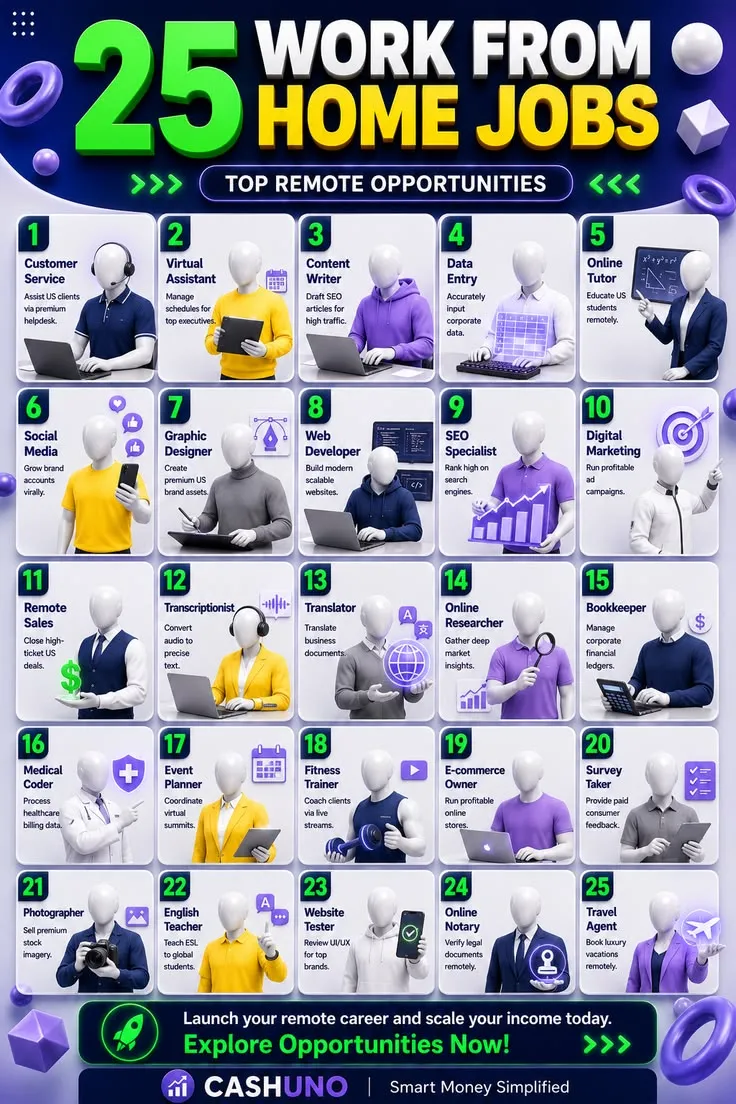
These remain among the most common and fastest-to-hire remote roles. Workers respond to customer questions through chat, email, or phone, resolve issues, process orders, and provide product information. Strong written and verbal communication, patience, and basic computer skills are the main requirements. Many employers supply training and equipment. Pay for entry-level positions often falls in the mid-teens to mid-twenties per hour, with some full-time roles offering benefits. Chat-based positions are especially beginner-friendly because they emphasize clear writing over phone skills.
Virtual Assistants
Virtual assistants handle administrative tasks such as email management, calendar scheduling, data organization, research, and basic project coordination. Organized individuals who are comfortable with tools like Google Workspace, Microsoft Office, Slack, or similar platforms can start here. Specialized virtual assistants who learn AI tools for drafting content or automating workflows often command higher rates over time. Starting pay commonly ranges from the high teens to the high twenties per hour, depending on responsibilities and client location.
Data Entry Clerks and AI Data Annotators
Data entry involves accurately inputting, updating, and organizing information in databases or spreadsheets. Attention to detail and decent typing speed are key. A related and growing area is AI data annotation and labeling, where workers review, categorize, or rate data used to train machine learning models. Demand for these skills has risen sharply. These roles suit detail-oriented beginners and often require little more than careful work and basic computer proficiency. Hourly rates typically start in the mid-teens and can reach the low twenties or higher for annotation work.
Online Tutors and Transcriptionists
People with subject knowledge or strong language skills can teach online or convert audio into written text. Online tutoring platforms frequently hire for a range of subjects and age groups; a bachelor’s degree helps in some cases but is not always mandatory. Transcription requires good listening skills and typing accuracy. Both offer flexible schedules and can serve as strong starting points for those who prefer independent work.
Junior Quality Assurance Testers and Content Moderators
QA testers check software, websites, or apps for bugs and usability issues. Content moderators review user-generated material against community guidelines. Both roles reward careful observation and consistency. Basic training is often provided, and pay generally sits in the high teens to low thirties per hour for entry-level work.
Sales Development and Appointment Setters
These positions focus on researching leads, making initial contact, and scheduling meetings for sales teams. Confidence in communication and comfort with outreach tools matter more than prior sales experience. Base pay plus commission is common, creating earning potential above pure hourly roles for strong performers.
Other accessible options include social media coordinators for small businesses, search quality evaluators, and junior administrative or research support roles. Across these positions, many employers have reduced or removed degree requirements, focusing instead on demonstrated skills and reliability.
Skills That Give Beginners an Edge
While many roles provide training, certain abilities improve hiring chances and speed advancement. Clear written communication stands out because so much remote work happens via chat and email. Basic proficiency with common software—spreadsheets, email platforms, and collaboration tools—is expected. Familiarity with AI tools for research, drafting, or simple automation is increasingly valued and can differentiate candidates. Attention to detail, time management, and the ability to work independently without constant supervision are essential for remote success.
Building a simple portfolio helps. Sample customer responses, a cleaned spreadsheet, a short tutoring lesson plan, or annotated examples of AI-related work demonstrate capability even without formal experience. Free or low-cost online resources make it realistic to practice these skills in a few weeks.
How to Find and Land Legitimate Opportunities
Focus on reputable job platforms that allow filtering for remote and entry-level positions. Company career pages of organizations known for remote hiring are also useful. Tailor applications to highlight transferable skills from school, volunteering, previous part-time work, or personal projects. Prepare for skills assessments or short writing tests that many remote employers use.
Be cautious of postings that request payment for training, equipment, or application fees. Legitimate employers pay their workers and supply necessary tools or reimburse approved expenses. Verify company details and read reviews carefully.
Building a Long-Term Remote Career
Starting in an entry-level remote role creates momentum. Customer service experience can lead to specialized support, team leadership, or operations positions. Virtual assistant work often expands into project coordination, marketing support, or executive assistance. Data-related roles provide a foundation for analytics or AI-focused careers. Continuous learning—particularly around AI tools, industry software, and communication—accelerates progress.
Remote work in 2026 rewards consistency, curiosity, and adaptability. Beginners who treat early positions as skill-building opportunities rather than permanent destinations often advance into higher-responsibility and higher-paying roles within a few years. The combination of flexible work arrangements and growing demand in support, administrative, and AI-adjacent fields makes this an especially practical time to begin a remote career.
Success starts with choosing one realistic role that matches current strengths, preparing the necessary basics, and applying consistently. With the right approach, work-from-home opportunities in 2026 offer a genuine and professional path forward for those ready to start.
Read more – starbiofact.com