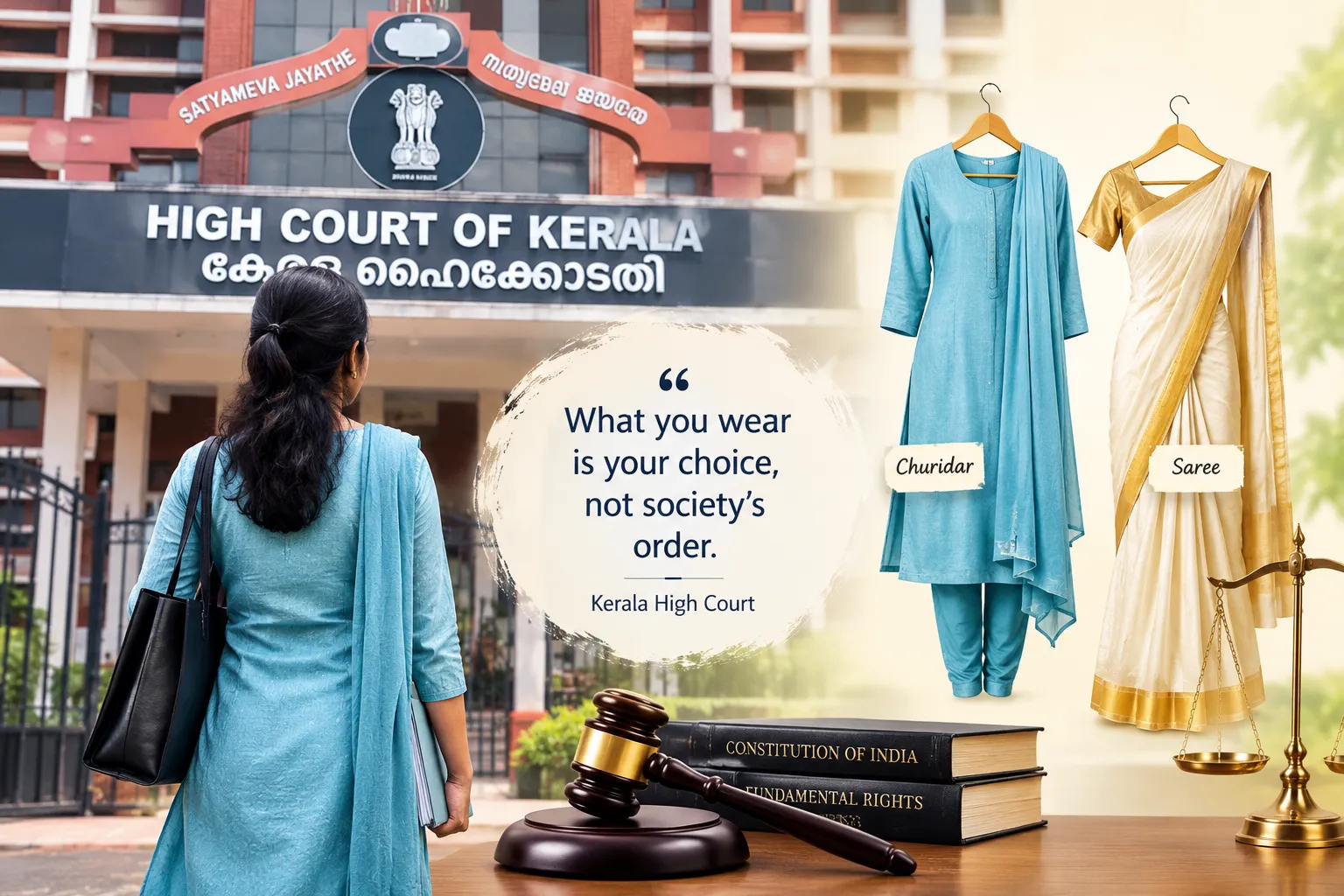
In a significant ruling affirming individual autonomy, the Kerala High Court has held that a citizen’s choice of attire is a personal matter protected as part of fundamental rights. Society or any individual cannot dictate what a person must wear in the absence of a clear legal mandate. The court delivered the observation while protecting a school headmistress who was allegedly denied entry to her institution for wearing a churidar instead of a saree.
The Incident That Reached the Court
The petitioner, Sindhu S. Nair, serves as headmistress of Eeswara Vilasom High School in Kottarakkara, Kollam district. She approached the High Court seeking police protection after the school manager allegedly objected to her wearing a churidar and instructed security personnel to prevent her entry. On one occasion in February 2026, she was stopped at the school gates. Police intervention later allowed her to enter, but the underlying dispute over dress continued.
The headmistress relied on a circular issued by the Directorate of General Education that permits teachers to wear churidars. She argued that the manager’s insistence had no legal basis and interfered with her ability to perform her duties.
Key Observations of the Court
Justice P.V. Kunhikrishnan made it clear that the case was not a contest between the saree and the churidar. The real question was whether a manager could convert personal preference into a binding command over an employee’s clothing.
The court declared: “What dress one wears is ordinarily a matter of personal choice of every citizen of this country. No one or society as a whole can dictate how a citizen should dress without the backing of the law. This is a part of the fundamental rights of every citizen.”
It further held that a citizen’s attire is his or her choice. Nobody can insist that it conform to society’s customs, nor can anyone dictate that it be in a manner acceptable to society, especially when no law supports such a demand. If any such dictate is issued, law-enforcing agencies have a duty to act promptly.
Dignity Is Not Tied to a Particular Garment
The judgment emphasised that clothes may express culture, comfort and individual preference, but they cannot ordinarily become a measure of a person’s worth or dignity. The Constitution does not make a woman’s dignity contingent on her conformity with another person’s preferred mode of attire.
A saree may be regarded as graceful by one individual, the court noted, but that personal view cannot be transformed into a compulsory uniform. Equally, a churidar worn decently and appropriately in a professional setting does not diminish the competence, decorum or authority of a headmistress.
The dignity and cultural meaning attached to any form of dress, the court said, should be decided by the person wearing it, not imposed by society or by an employer’s private notions.
Limits of Managerial Authority
The ruling carefully distinguished between legitimate institutional dress codes backed by law or clear rules and the imposition of personal taste. In this case, the government circular expressly permitted churidars for teachers. The manager therefore had no authority to override that permission or to obstruct the headmistress on the basis of his own preference.
The court directed that the headmistress should not be prevented from entering the school or discharging her duties on account of her choice of attire. It also underscored the responsibility of police and education authorities to ensure that such interference does not recur.
Broader Implications for Personal Liberty
Although the dispute arose in a school setting, the principles articulated by the High Court carry wider significance. The judgment reinforces that personal autonomy in matters of dress forms part of the fundamental rights guaranteed to every citizen. Restrictions are permissible only when they rest on valid legal authority—such as a uniform code prescribed by statute, regulation or a properly framed institutional rule applied uniformly.
In the absence of such authority, neither social expectations nor the preferences of an employer or manager can be enforced through coercion or denial of access. The court placed a corresponding duty on law-enforcement agencies to protect citizens when their right to choose their attire is infringed.
A Clear Message on Gendered Expectations
The case also touches on the frequent tendency to link a woman’s professional dignity to specific forms of traditional clothing. By rejecting the idea that dignity depends on conformity with another’s preferred dress, the High Court pushed back against informal norms that disproportionately scrutinise women’s appearance in workplaces.
The ruling affirms that an educated professional’s competence and authority are independent of whether she chooses a saree or a churidar, provided the attire is appropriate to the setting. That distinction between personal choice and legitimate professional standards is central to the judgment.
Conclusion of the Proceedings
The High Court disposed of the petition with a clear declaration of the legal position and directions to ensure the headmistress faces no further obstruction. While leaving certain factual disputes to ongoing administrative processes, the court left no ambiguity on the core constitutional principle: attire is a matter of individual choice, and neither society nor any private individual can dictate it without the backing of law.
In doing so, the Kerala High Court has reaffirmed a basic tenet of personal liberty. A citizen’s right to decide what to wear, within the bounds of decency and any valid legal requirement, remains protected. Attempts to enforce private preferences under the guise of tradition or propriety will not stand when they lack legal foundation.
Read more – thebnssection.com