Sixteen years after The Social Network introduced audiences to a young Mark Zuckerberg as an ambitious Harvard dropout building a revolutionary platform, Aaron Sorkin returns to the same universe with a markedly different perspective. In The Social Reckoning, the writer-director shifts the focus from invention to consequence. The new film places Zuckerberg’s decisions at the centre of a story about misinformation, political division and the broader impact of social media on democracy, promising a portrayal that is both complex and uncompromising.
A Companion Piece, Not a Simple Sequel
The Social Reckoning is structured as a standalone companion to the 2010 Oscar-winning film rather than a direct continuation. Sorkin has described the earlier movie as the story of how Facebook was invented. The new project examines what the company has become. Where the original centred on dorm-room ambition, lawsuits and the creation of a social network, this film turns its attention to the platform’s evolution into a global force whose algorithms shape public discourse.
The narrative follows whistleblower Frances Haugen, a former Facebook data engineer, and Wall Street Journal reporter Jeff Horwitz. Haugen’s decision to leak thousands of internal documents in 2021 revealed that the company was aware of significant harms linked to its products, including effects on teenage mental health, the spread of misinformation and the amplification of polarising content. Those disclosures formed the basis of the widely reported “Facebook Files.” Sorkin’s screenplay draws on these events, presenting them through the dual perspectives of the insider who risked her career and the journalist who helped bring the material to light.
Recasting Zuckerberg for a New Era
Jesse Eisenberg, who earned an Academy Award nomination for his portrayal of Zuckerberg in The Social Network, declined to reprise the role. Sorkin has stated that he spent several days attempting to persuade Eisenberg to return, believing the part belonged to him. Eisenberg ultimately chose not to continue the association, citing discomfort with being publicly linked to the real-life figure. Jeremy Strong, known for intense, immersive performances, stepped into the role.
Sorkin has been clear about how he approaches the character. He does not present Zuckerberg as a conventional villain. Instead, he describes him as an antihero. In Sorkin’s view, a villain acts from malicious intent, while an antihero begins with positive aims that lead to damaging outcomes. Zuckerberg’s stated goal of connecting the world remains the starting point. The film then examines the decisions made as the company grew into a trillion-dollar entity serving billions of users, particularly the prioritisation of engagement-driven algorithms that critics argue intensified division and falsehoods.
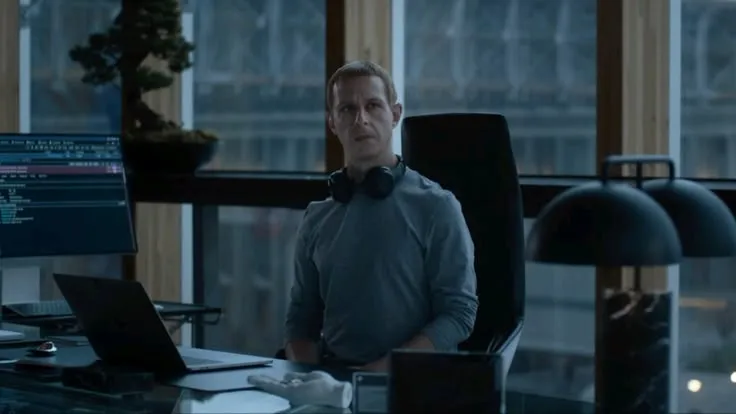
This framing allows the portrayal to remain rigorous without descending into caricature. Strong’s Zuckerberg is older, wealthier and far more powerful than the figure audiences first met. The company’s news feed, once a tool for staying in touch with friends, now functions as a primary source of information for large segments of the population, with each user receiving a personalised and potentially distorted version of reality.
The Whistleblower and the Reporter at the Centre
Mikey Madison plays Frances Haugen, the engineer who collected internal research showing that Facebook and Instagram were aware of negative effects on young users and on the quality of public conversation yet continued practices that maximised time spent on the platforms. Jeremy Allen White portrays Jeff Horwitz, the reporter who worked with Haugen to analyse and publish the findings. Their collaboration drives the narrative, transforming complex corporate data into a public reckoning.
The film is structured as a newsroom and legal thriller, following the high-stakes process of verifying documents, navigating legal risks and preparing the material for publication and congressional testimony. Sorkin’s dialogue-driven style, familiar from earlier works, is applied to the tension between corporate self-interest and public accountability. Supporting roles, including members of Zuckerberg’s legal team, expand the institutional landscape surrounding the central figures.
Examining Algorithms, Free Speech and Responsibility
A core theme of The Social Reckoning is the distinction between free expression and the unchecked circulation of falsehoods. Sorkin has described himself as a free-speech absolutist while acknowledging practical limits, such as the classic prohibition against falsely shouting “fire” in a crowded theatre. The film explores how algorithmic amplification can turn private speech into a public hazard, particularly when it rewards outrage and extremism because those emotions drive engagement.
Internal research referenced in the real Facebook Files indicated that the company understood certain design choices contributed to polarisation and mental-health challenges among teenagers. The dramatisation places those findings in the context of decisions made at the highest levels. Zuckerberg’s character defends the platform’s neutrality and commercial imperatives, while the whistleblower and reporter press the case that indifference to consequences is itself a form of responsibility.
Legal Scrutiny and Dramatic Intent
Because the film depicts living individuals and recent corporate events, it underwent careful legal review. Sorkin has noted that certain details and chronology were adjusted for dramatic coherence while remaining rooted in documented events. The result is a legally vetted newsroom drama that aims to illuminate rather than simply indict. The focus remains on the systemic effects of product decisions rather than personal demonisation.
Audiences familiar with The Social Network will recognise the sharp, rapid-fire exchanges and moral complexity that characterised Sorkin’s earlier script. The difference lies in scale and consequence. The earlier film dealt with friendship, ambition and intellectual property. The Social Reckoning confronts the societal cost of a product used by roughly three billion people.
Timing and Cultural Resonance
The film arrives at a moment when debates about social media’s role in democracy, mental health and information integrity continue to intensify. By revisiting the 2021 disclosures through the dual lenses of Haugen and Horwitz, Sorkin provides a dramatised account of how internal knowledge became public evidence. The portrayal of Zuckerberg as an antihero whose original vision collides with unintended outcomes offers a more layered examination than simple hero-or-villain framing.
Jeremy Strong’s performance is expected to anchor the institutional side of the story, while Madison and White carry the investigative momentum. Together they form a triangle of power, conscience and exposure. The film does not claim to resolve the larger questions surrounding platform accountability. Instead, it places those questions in a dramatic framework designed to hold attention while examining the choices that shaped a generation’s primary information environment.
The Social Reckoning stands as Sorkin’s attempt to complete a cinematic arc that began with invention and now confronts impact. By refusing both hagiography and cartoonish villainy, the director presents Mark Zuckerberg as a figure whose decisions continue to influence the public square, inviting audiences to consider the distance between connecting the world and the world that connection has produced.
Read more – wardrobeoops.com